
As Brene Brown says: "clear is kind and kind is clear" - we discuss why clarity should be baked into organisational culture for effective strategy execution.
Clarity in our environment is a fundamental tenant of any improvement and sustained success. Yet all too often we find ourselves in a world of assumption, fuzzy boundaries and grey areas that make life difficult for people, process and customers alike.
Establishing and maintaining a currency of clear standards across all facets of our process environment is critical. Clarity here drives the creation of robust processes that repeatably deliver the desired outcomes of our production or service.
Strategy Execution Requires Clarity
People are products of their environment. If that environment lacks clarity on its purpose, direction, structure, expectations (internal and external), boundaries, and required discipline we cannot hope to achieve a culture of high performance. We cannot hope to achieve a culture of learning and improvement either.
In many instances people are crying out for leadership and direction; they're crying out for support and consistency. Yet all too often the message does not translate, the goal posts shift or the organisation simply does not know what to do or how to do it. Being clear helps us to cut through all of this unnecessary noise.
Being clear starts with our overall goals and objectives. Who are we as an organisation? What is our purpose? Where do we want to go and how do we think we will get there? What are our core values?
It means that we are clearly defining the structure of our business, the roles and responsibilities that lie within it and the level of performance that we expect from our team.
Great Cultures Thrive on Clarity
We have to break it down to the point that every single task or behaviour has intention and purpose. It all must be clearly aligned with developing the daily habits and focus that create an environment capable of propelling us forward.
Clarity requires clear communication and constant messaging. It requires an environment that speaks to us verbally, visually and engages our hearts and minds.
Clarity of purpose should be the fundamental building block of standardisation and improvement – What are we trying to achieve? How are we trying to achieve it? What are the standards that must be observed in order for us to meet the requirements?
From a purely cultural viewpoint clarity is a must – great cultures thrive on clarity. Teams and individuals should be provided with clearly defined and repeated messaging around expectations, combined with accountability through exposure and good quality feedback mechanisms.
Toxic Culture Impedes Strategy Execution
Left unchecked, poor performance and behaviour can become toxic to an organisation. They set the bar low and allow incongruence within the population. This inevitably leads to frustration, migration, and a tangible lack of stimulus to change, learn or improve.
Let's say that the distribution sits across a scale of 0 to 10. If we are not clear on where we want to be we will typically see a spread from 9 to 2 with a mean of perhaps 4 or 5. This means we are allowing people in our environment that are 2s and 3s out of 10 to comfortably function without intervention.
The point being: nothing changes unless we are clear on expectations and are active in ensuring those expectations are consistently met through accountability and feedback.
This is where being clear is being kind. In an ambiguous environment many people simply do not know what is expected. When we can provide clarity across the board then the conversation changes. Clarity creates inclusion, connection and understanding. It helps to drive curiosity and critical thinking and it ultimately helps people to optimise their time and effort toward the right objectives.
View Strategy Execution as Part of the Greater C.I. Framework
For effective strategy execution we must ensure alignment of all the people, processes and systems involved. Lean tools like standardised problem solving techniques, Standard Operating Procedures (SOPs), and a Tiered Daily Management process that supports the entire PDCA loop are key to achieving strategy success.
The illustration below demonstrates how we designed the interconnected TeamAssurance platform to avoid locally optimised, disconnected 'Point Solutions' (digital or analog) that do not help, and may even hinder your organisation's strategy deployment goals.
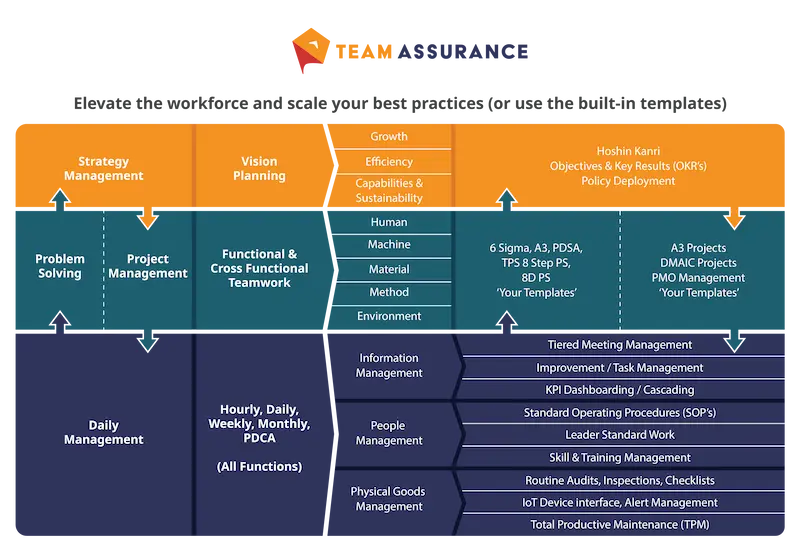
Bake in clarity of purpose, vision and process with TeamAssurance. If you're a business in need (or a consultant with clients in need) and you'd like to explore the opportunities that digital-aids to Lean tools provide contact us for a demonstration today.