
Identifying leader standard work and implementing documentation to support accountability is the key to unlocking proactive potential.
"I'm too busy" – it's a catch cry we hear all too often from leaders. It's far too easily accepted and excused but not often challenged in our modern workplace. The questions are – what are we busy doing? Are we adding value and working on the right things?
In my experience, frontline and middle managers are the barometer for where an organisation and its processes are on the spectrum from abject chaos to stability/control. This creates a significant dilemma for most, if not all, organisations undertaking change processes and continuous improvement activity.
An unstable process with poor organisational and personal structure will drive this highly reactive management culture. Leaders are stuck continually firefighting and problem-solving in the moment. This is not a sustainable model for the organisation, nor the individual stuck in a rut.
The "too busy" dilemma is primarily an indicator of an absence of process or processes that are broken or negotiable. The leaders must wrestle with the process daily to achieve the desired outcomes.
There is also an element of choice and ambiguity that comes into play here. Individuals who lack clarity and focus on their core functions often choose to prioritise low value activity over key tasks.
Standards Are Imperative to Continuous Improvement
The bedrock of any continuous improvement activity in an organisation is based on standards. All activity is ideally highly standardised and highly specified. A leader's daily activity should be no exception, thus the development of leader standard work as an antidote to support the highly reactive, unfocussed, and overburdened leader.
Leader standard work is a key element in the integrity of an organisation's structure and its ability to translate, implement and deliver strategic outcomes. It is also key to facilitating the critical feedback from the process and frontline employees.
Identifying Leader Standard Work
The starting point for developing leader standard work is to assess the organisational structure. We must ensure that it supports the process objectives and that each role has a clearly defined scope. This scope of role and responsibility then distils down to a clear set of key "must do" high priority tasks and activity.
This forms the basis of the leader standard work document along with medium and low priority tasks termed as "should do" and "nice to do". This immediately paints a picture of the leaders' range of tasks and the current commitment in time and focus to those tasks.
The next step is assessing the leaders' capacity. In my experience it is not uncommon to see middle managers working between 60 to 70 hours per week – consistently. This is not a sustainable situation in any way, shape or form.
As a rule of thumb no more than 45 hours should be allocated as a leaders capacity. The goal should be to have a mix of 80% planned activity to 20% free for reactive or additional proactive work.
The Leader Standard Work Document
This is no more than a checklist for each day over the course of a week. The document would first be populated with the "must do" activity by inserting each activity into an appropriate time slot and allocating an average time for the task. In essence – what is the high priority task? When is the best time to do it? How long does it take?
This sounds like a very simple and common sense exercise so far – and it is. However, the challenge is then to follow this structure each and everyday. You must ensure that the leader's time is being utilised effectively through focus on the key priorities of the role.
These initial steps immediately provide a leader with a true north for daily activity and will expose firefighting and work outside of the leader's scope. They will set basic boundaries and focus ensuring that the core elements of the work are allocated and executed consistently.
Standardisation of work should capture the "current best way" to undertake any activity in the organisation. It ensures that a standard is documented and repeatable. This is no different for a process task or the activity a leader undertakes each day.
As Taiichi Ohno said – "Without standards there can be no Kaizen".
Leader Standard Work is Part of a Greater C.I. Framework
We must remember that Leader Standard Work is one part of a greater framework when it comes to improvement. The alignment of all the people, processes and systems involved requires open communication and integration of all adjacent processes. Lean tools like standardised problem solving techniques, Standard Operating Procedures (SOPs), and Tiered Daily Management that supports the entire PDCA loop are key to achieving our continuous improvement objectives.
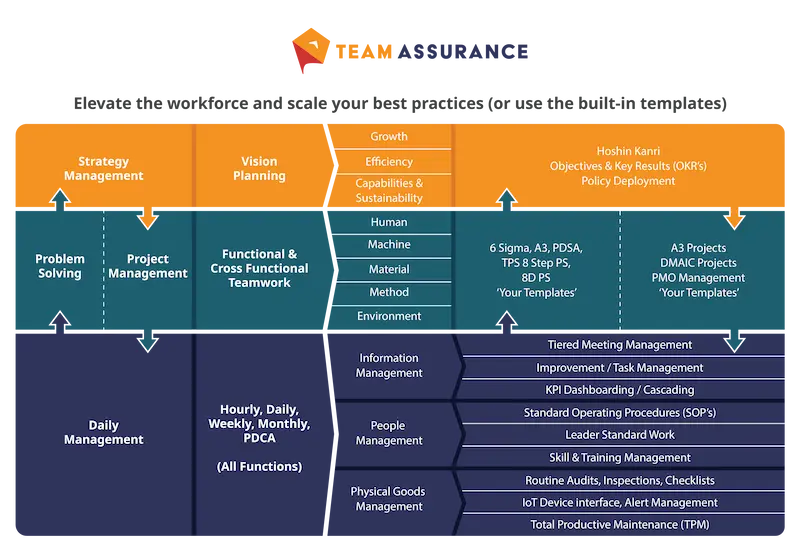
The diagram below demonstrates how we designed the interconnected TeamAssurance platform to avoid locally optimised, orphaned 'Point Solutions' (digital or analog) that do not help, and often hinder your progress towards the organisation's objectives.
If you're a business in need (or a consultant with clients in need) and you'd like to explore the opportunities that digital-aids to Lean tools provide contact us for a demonstration of the TeamAssurance platform today.